

There was a moment in time when collaborations carried weight. You could feel the intention behind them. Two identities meeting with purpose. Two creative worlds finding a shared direction. Two brands saying something together that they couldn’t say alone. Those collaborations shaped culture because they had a reason to exist.
Today, that feeling is rare.
Somewhere in the last few years we drifted into a landscape where collaborations have become the default move. A safety blanket. A marketing reflex. A quick hit of relevance. The cultural magic that once defined them has been replaced by something flatter. Something made to fill feeds rather than shape conversations.
You can feel the difference instantly.

A cultural collaboration introduces friction. A little tension. A new POV. The work feels alive because both identities are bringing something of their own to the table.
A content collaboration feels weightless. Neat. Predictable. Harmless. Two logos aligned and formatted for social distribution. You can almost hear the internal meeting that created it. This is collaboration as strategy rather than collaboration as expression.
The industry has started to use partnerships as a form of identity outsourcing.
When a brand lacks a point of view, a collaboration becomes an easy way to borrow someone else’s. It offers the illusion of cultural currency without the work of building a voice. But identity cannot be rented. Not sustainably. And not in a way that people actually feel.
This is the part no one likes to say out loud. If a brand struggles to make cultural impact alone, a partnership will not fix that. It will only expose it. True collaborations amplify strong identities. They do not compensate for weak ones.

The strongest partnerships today come from brands who know exactly who they are before they enter the room. They carry clarity. They protect their lane and they bring their own taste, not a template. That is why their collaborations feel like world-building. They expand the universe rather than dilute it.
The rest is noise. Nice imagery. Clean assets. A few days of hype and a short shelf life.
I think people are bored of it because the truth is simple. Collaboration is supposed to feel cultural. It is supposed to feel like someone took a risk. Like two creative languages learning each other in real time.
When it becomes content, it loses its power.

So before another co-sign hits the feed, it might be worth asking a harder question. Do these two brands actually have something to say together, or are they just sharing the same stage for exposure and a lack of stage presence?
If the answer is unclear, the collaboration will be too.
That is the difference between culture and content.
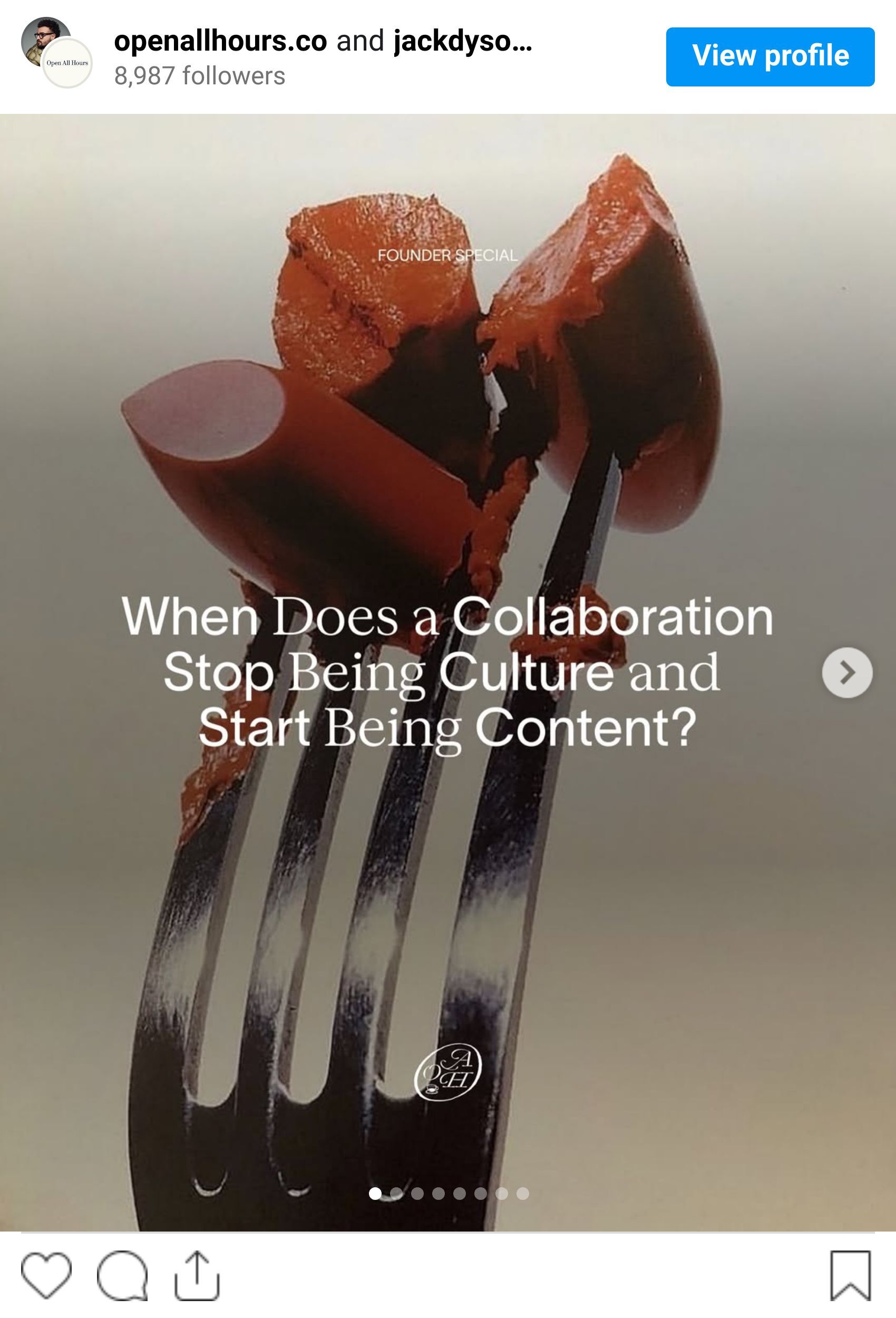
Shot of the good stuff
